
Lee Van Sickle
The benefits of managed IT services are gaining recognition as businesses seek greater stability and smarter ways to run their operations.
Leaders are turning toward solutions that cut through complexity, give them sharper visibility, and create confidence in the systems that keep everything moving. This approach positions IT as a central part of business growth, rather than a background function.
Studies show that organizations using managed services achieve 45-65% cost savings compared to internal IT groups. Those savings go beyond simple expense reduction—they allow teams to invest in innovation, improve security frameworks, and direct resources where they deliver the most impact.
The result is a more efficient operation that is financially stronger and technologically sharper.
Ben Myslenski, Owner and President at TEC Communications, says, “Technology that is actively managed becomes the foundation on which stronger businesses are built.”
This captures the real takeaway: managed IT services are a framework for resilience, scalability, and long-term success.
Companies that embrace this model give themselves the clarity and structure needed to compete with confidence.
Learn how forward-thinking businesses are simplifying operations while fortifying security through intelligent managed IT services.
Leveraging the benefits of managed IT services has become a central theme in how companies think about technology. Businesses no longer want IT to be reactive; they want it to be structured, predictive, and aligned with growth. The shift toward managed models reflects a demand for clarity and control in a world where downtime costs more than ever.
Organizations are turning to managed IT because predictability is priceless. With fixed service models, leaders can calculate risk, control costs, and plan with confidence.
This strategic alignment helps executives think less about day-to-day IT struggles and more about long-term innovation.
Security is one of the clearest advantages of managed IT. Companies can no longer afford partial protection when threats evolve daily. Worldwide spending on data security has reached $81.6 billion, showing how vital this area has become.
By integrating these security measures, businesses turn vulnerabilities into opportunities for resilience.
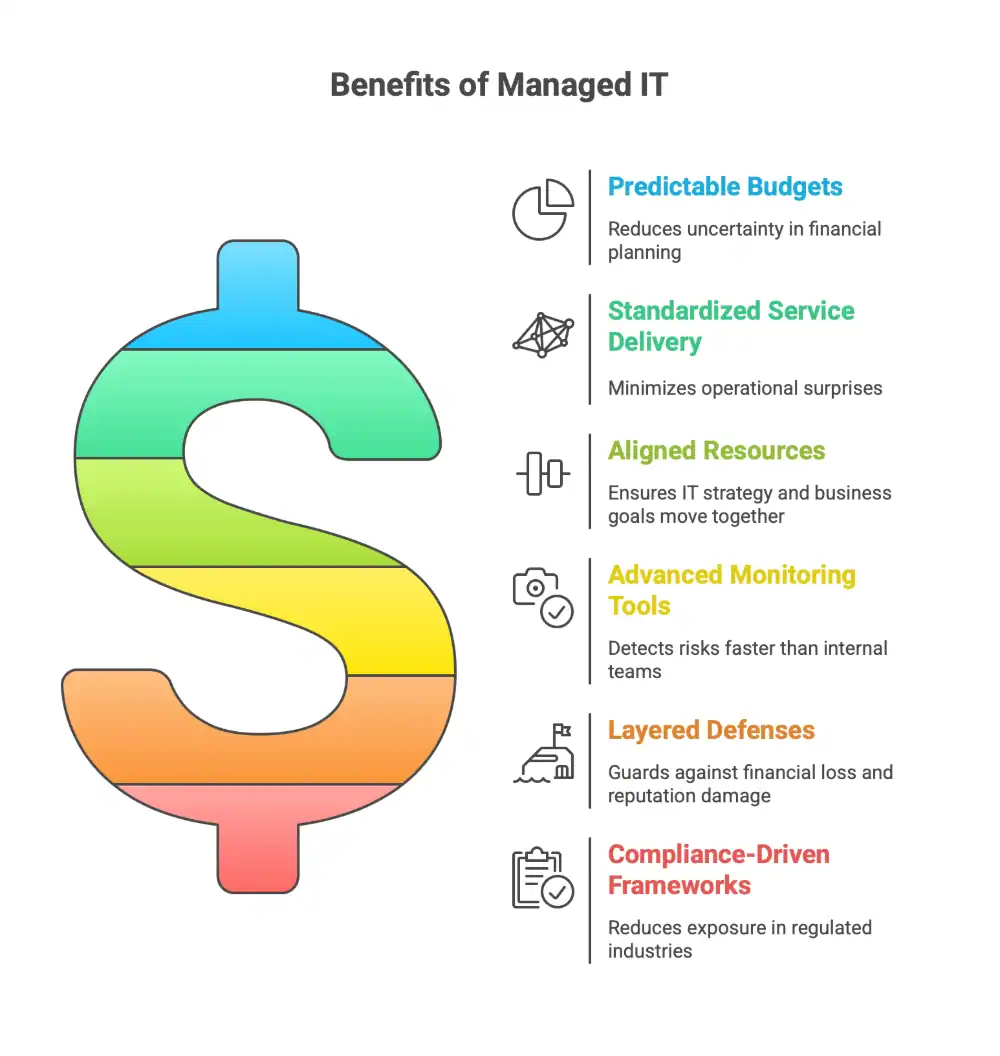
Managed IT is mostly about expanding business value. Providers deliver specialized expertise that internal teams often lack, creating stronger operations.
The real benefit lies in elevating IT from a support function into a driver of competitive advantage.
The importance of managed IT services lies in how they reshape business strategy. Growth today depends on having IT models that cut waste and sharpen decision-making. Leaders see managed IT as a lever for cost control and smarter allocation of resources.
Companies are finding real value in the predictable pricing of managed IT. The ability to forecast expenses without the volatility of break-fix models helps direct capital into higher-return initiatives.
The average spend per employee in the managed services market is projected to reach US$6.87 in 2024, underscoring how businesses are turning to managed IT as a disciplined way to scale without inflating overhead. This financial clarity supports investment in both stability and innovation.
When daily operations run more efficiently, every department gains momentum. Managed IT reduces bottlenecks in communication, speeds up task resolution, and makes collaboration tools more effective.
The impact reaches beyond technology, creating a culture of smooth, uninterrupted progress.
The data insights provided by managed IT services allow executives to make sharper decisions. Performance metrics, usage analytics, and resource reports move technology from guesswork into evidence-driven planning.
By analyzing trends, organizations uncover opportunities to optimize operations and anticipate needs before they arise. This intelligence transforms IT into a strategic contributor to growth.
The advantages of managed IT services that matter most in turbulent times are those that protect business continuity. Disruptions caused by outages, cyber events, or sudden demand shifts can quickly damage both revenue and reputation. Resilience becomes the deciding factor between recovery and collapse.
Continuity planning is no longer optional. Managed IT integrates structured recovery systems into daily operations, preparing companies to withstand interruptions without losing momentum. Providers bring tested strategies that adapt to different industries, ensuring uptime and reliability remain intact. Preparedness is built into the service model.
Risk is layered across infrastructure, users, and external threats. Managed IT services minimize this exposure by weaving proactive safeguards into normal operations.
With these safeguards in place, companies experience fewer surprises and greater confidence in their ability to respond to crises.
Resilience also means adaptability. Managed IT enables organizations to scale systems up or down in response to demand, without long procurement delays. This agility is crucial during market volatility, when companies need immediate flexibility. Adaptation becomes a built-in strength rather than a last-minute scramble.
Resilience AreaWhat It Really MeansWhy It MattersIncident ReadinessPlaybooks for responding to IT disruptions.Faster recovery and less downtime during outages.Workforce ContinuitySecure remote access and collaboration tools.Employees remain productive with secure remote access and reliable collaboration tools.Third-Party CoordinationManaging vendors and providers during recovery.Integrated vendor management ensures outside providers align with recovery timelines.Performance BenchmarksRegularly testing and validating resilience plans.Validates that resilience plans meet evolving operational demands.Cultural PreparednessTraining employees to respond calmly and effectively.Reduces chaos, strengthens organization-wide resilience
The managed services advantages that carry the most weight are those that prepare businesses for growth. By combining scalability with innovation, organizations can expand confidently and adopt new technologies without unnecessary delays.
This scalability ensures technology evolves in step with organizational ambition.
Innovation becomes a sustainable advantage when guided by managed services that balance foresight with execution.
The right provider delivers more than services; they deliver confidence. With decades of expertise and a focus on measurable outcomes, TEC helps organizations build IT systems that strengthen performance and reduce risk. Every solution is designed to adapt to the pace of modern business.
Trusted Managed IT Services Near You
Take the next step in transforming IT into an advantage – contact us to explore what’s possible.