

Lee Van Sickle
Today’s companies are navigating an increasingly tangled web of IT demands, and the impact is real. A recent Ponemon Institute report revealed that 64% of organizations experienced major disruptions last year due to ongoing IT issues.
Even more concerning? Around 60% of small businesses shut down within six months of experiencing a significant cyberattack. These numbers highlight why relying on reactive, break-fix IT models is no longer a sustainable option.
For many teams, tackling this complexity alone is not only complex but downright unmanageable. That’s where expert managed services step in.
“Relying on a solo technician or a small internal team to oversee your company’s entire IT infrastructure is a gamble,” explains Ben Myslenski, Owner and President at TEC Communications. “Working with a professional IT provider gives you access to a deeper bench of expertise across multiple tech domains.”
But before diving in, one question needs to be answered: What are managed IT services? This article breaks down the managed IT services definition, explores it in practical terms, and explains precisely how managed services work to strengthen your business operations.
Enhance your IT management efficiency with a trusted partner.
So, what exactly are managed IT services? Put simply, the definition of managed IT services involves outsourcing the oversight and maintenance of your IT systems to a third-party provider.
Instead of relying on an in-house team, businesses collaborate with external specialists who proactively manage their infrastructure, ensuring consistent and reliable performance.
This shift away from the traditional IT model is more than a trend; it’s a strategic move. Even seasoned IT professionals often find that internal management consumes time and resources that could be better spent on business growth.
When you offload your tech responsibilities to an MSP, your team can stay focused on high-priority initiatives. And the savings can be substantial. According to a CompTIA study, 50% of companies working with a managed services partner saw IT cost reductions of 1-24%.
Furthermore, another 33% experienced savings of 25-49%, and 13% slashed costs by more than 50%.
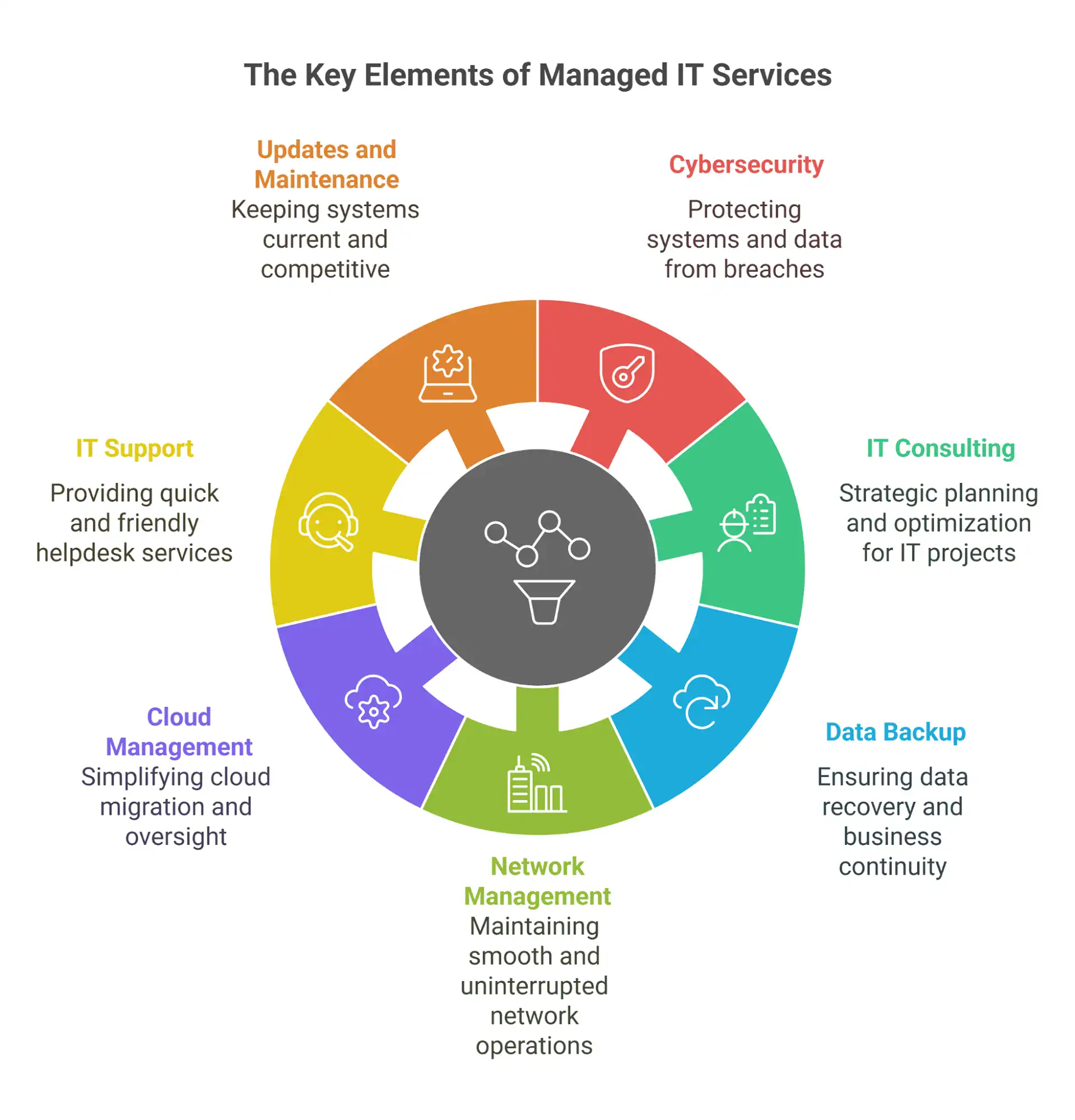
To understand what managed services truly deliver, and why 73% of companies have deployed them in some areas of their businesses, it’s helpful to explore what they encompass. These are the pillars of support offered by a professional provider:
With the average data breach costing nearly $4.9 million, solid protection is essential. MSPs implement the latest defenses to shield your systems, users, and sensitive information.
A striking 70% of IT projects fail to meet their goals, according to Deloitte. That’s why vCIOs and expert consultants are critical for long-term success, helping you plan, budget, and optimize effectively.
MSPs provide secure backups and disaster recovery solutions that help your business recover quickly in the event of an unexpected incident.
These services ensure your IT network operates smoothly, minimizing outages and maintaining uninterrupted connectivity.
From migrations to daily oversight, MSPs simplify your move to and use of the cloud.
Fast and friendly helpdesk services ensure issues get resolved quickly, minimizing disruptions.
Your systems stay current and competitive through regular software and hardware upgrades.
A professional IT partner doesn’t just fix problems. They become a seamless extension of your internal team. Whether you’re looking to supplement a few roles or completely hand off your IT operations, working with a provider offers measurable advantages.
Here’s how managed services work to improve business performance:
Say goodbye to unpredictable repair bills and hiring costs. A flat monthly fee enables small and mid-sized businesses to plan their budgets more effectively while receiving reliable support.
With a managed provider, you tap into a pool of highly skilled professionals, experts your business may not be able to afford to hire in-house.
Instead of scrambling when things go wrong, MSPs resolve issues before they escalate. This preemptive approach minimizes disruptions and maximizes uptime.
From firewalls to threat detection, MSPs implement layered protection strategies to guard your data and systems from unauthorized access and breaches.
As your business grows, so does your IT support. Managed services enable you to scale resources up or down as your needs evolve.
Free up your internal teams to focus on core business initiatives instead of juggling IT tasks that divert them from strategic priorities.
Recognizing the right moment to bring in outside IT expertise can make a significant difference in your company’s productivity and resilience. Here are a few signs that it might be time to rethink your approach and consider what an IT managed services provider can support:
If your business is scaling quickly, your current IT setup may struggle to keep up. Managed services provide the flexibility to meet growing demands without overextending your internal team.
Regular downtime, recurring errors, or unreliable technology performance can signal deeper infrastructure issues. Partnering with an IT provider ensures you have consistent, expert-level support that addresses root causes, not just symptoms.
Does your business operate in a highly regulated sector, such as healthcare or finance? Staying compliant isn’t optional. A trusted provider helps manage IT in alignment with strict regulatory requirements, protecting your organization from penalties and reputational harm.
Feature/AspectTraditional IT ServicesManaged IT ServicesSupport ApproachReactive: Problems are addressed after they occurProactive: Issues are monitored and prevented in real timeCost StructureUnpredictable, per-incident chargesFixed monthly fee, scalable based on business needsAccess to ExpertiseLimited to internal resourcesBroad expertise from multiple specialistsSystem MonitoringUsually manual and infrequent24/7 monitoring and automated alertsCybersecurity MeasuresBasic antivirus or firewall setupComprehensive, layered security and compliance managementScalabilityDifficult to scale without significant investmentEasily scales with business growthDowntime ManagementDowntime is often prolonged due to delayed responseRapid response and proactive issue preventionStrategic IT PlanningRare or nonexistentIncluded via vCIOs and IT consultants
When you understand the meaning of managed IT services and the value behind partnering with the right provider, adopting managed services becomes a strategic business decision, not just a technical upgrade.
At TEC Communications, we go beyond the basics to deliver tailored IT solutions that align with your business goals, whether that means tightening your cybersecurity posture, resolving recurring IT issues, or supporting future growth.
Trusted Managed IT Services Near You
What managed services can deliver goes well beyond basic technical assistance. It’s all about finding a long-term partner who is invested in your success.
Ready to take the next step? Contact us today to schedule your complimentary consultation and discover how we can help you confidently refine your IT strategy.