

Lee Van Sickle
Choosing the wrong IT partner isn’t just inconvenient; it’s expensive. According to IBM’s Instana Report, 98% of organizations reported IT-related costs exceeding $100,000, underscoring how misaligned vendor relationships can lead to wasted investments, stalled projects, and lost productivity.
Your IT environment is the backbone of your business, and the provider you choose will either accelerate growth or quietly sabotage it.
Ben Myslenski, Owner and President at TEC Communications, says, “The right managed services provider should feel like an extension of your team, not just a vendor you call when things break.”
So how do you find the one that fits like a glove? This guide will help you find the right fit.
You’ll learn what to evaluate, which questions to ask, and the criteria that reveal whether an MSP is truly built for your business. We’ll discuss how to spot red flags, decode service level agreements, and assess whether a provider can scale with you.
Learn how our certified team delivers measurable outcomes with proactive support and expert guidance for your business.
The role of IT has undergone a dramatic evolution. Today, businesses rely on technology not just to run internal processes, but to drive revenue, deepen customer engagement, and spark innovation. Outsourcing IT to a managed services provider (MSP) offers clear advantages, including lower costs, stronger security, and access to specialized expertise that may be missing in-house.
But the risks of choosing the wrong partner are real and costly. A weak MSP may lack the resources to protect sensitive data, respond quickly to issues, or scale with your growth.
According to Splunk’s 2024 Cost of Downtime Report, 60% of enterprises face customer loss after an outage, with recovery often spanning months, leading to lost revenue and diminished customer trust.
The right MSP is a strategic ally. A qualified provider helps you:
This makes the decision far more than a transactional purchase; it’s a long-term business strategy. When your MSP understands your goals and integrates seamlessly with your team, your IT infrastructure becomes a growth engine, not a liability.
Choosing a managed services provider (MSP) is about finding a partner who can evolve with your business, protect your assets, and deliver consistent value. To avoid short-term fixes and long-term regrets, apply a rigorous evaluation process.
Here are the criteria that matter most:
Your MSP should demonstrate advanced knowledge in networking, cybersecurity, and cloud infrastructure. Look for certifications like Microsoft, Cisco, or CompTIA. They signal ongoing investment in technical excellence.
Providers familiar with your sector understand your workflows, compliance requirements, and operational nuances.
Whether you’re in healthcare, finance, or construction, industry-specific experience reduces onboarding friction and improves outcomes.
A modern MSP should offer end-to-end IT support, including managed security services, cloud management, helpdesk, compliance, and disaster recovery. The broader the offering, the fewer vendors you’ll need, and the smoother your operations will run.
Your IT needs won’t stay static. Choose a provider that can scale with you, adding users, expanding infrastructure, and adapting services without disruption or costly renegotiations.
Focusing on these areas ensures you’re investing in long-term capability, strategic alignment, and operational resilience.
Choosing a managed services provider (MSP) isn’t just about pricing; it’s about trust, capability, and long-term alignment. The questions you ask during evaluation will reveal whether the provider can truly support your business goals or simply patch problems as they arise.
Start with operational performance:
These questions help you gauge how quickly and effectively the MSP reacts when things go wrong and whether they’re proactive or just reactive.
Dig deeper during discovery calls to uncover service depth:
These reveal the MSP’s technical maturity and how well they align with your compliance and visibility needs.
Don’t skip the technical qualifiers:
Annual losses from cybercrime were projected to reach $10.5 trillion by 2025. These questions ensure the provider can meet your security and regulatory obligations without compromise.
Asking the right questions provides strategic foresight. You get a full view of the MSP’s capabilities, culture, and commitment to your success. The goal is to find a provider that has the capacity to strengthen your business.
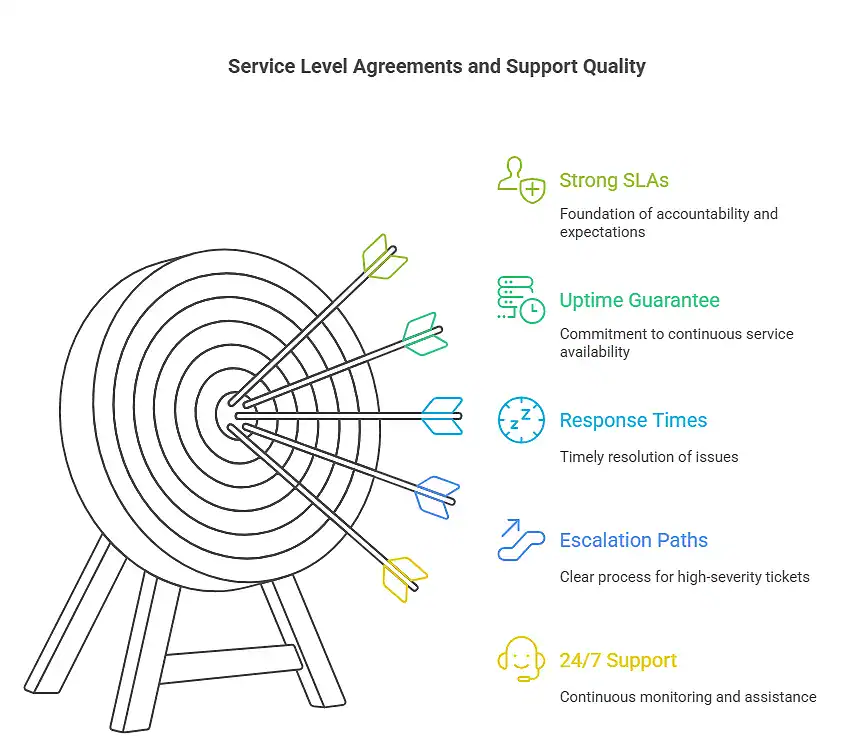
SLAs define accountability. Strong SLAs include guaranteed response times, clear escalation paths, and uptime commitments. Weak SLAs leave room for missed expectations.
Support quality matters just as much. You need 24/7 monitoring, not coverage that ends at 5 PM.
Key questions to ask:
Together, SLAs and support reveal whether an MSP can perform under pressure or fall short when it matters most.
Security is foundational. When evaluating managed security services, look for robust safeguards that protect your data and reputation. Ask providers about:
Compliance is just as critical. Whether you operate under HIPAA, PCI DSS, or NIST, your MSP must support the frameworks that govern your industry.
According to Business Wire, 50% of those surveyed admitted that compliance failures stemmed mainly from inadequate leadership and direction. The takeaway? If a provider can’t help you stay compliant, they’re not the right partner.
MSP pricing can be confusing. Some charge per user, others per device, and some offer flat-rate subscriptions. To avoid budget blowouts:
Transparent pricing helps you invest in sustainable, scalable support, not just the cheapest option. Value beats bargain when your business is on the line.
Trust starts with transparency. A reliable MSP provides regular updates, clear communication, and tools that give you full visibility into your IT environment.
Dashboards, analytics, and ticketing portals help you monitor system health and support performance in real time.
Lack of visibility creates blind spots. If a provider avoids sharing detailed reports, they may be masking inefficiencies. Consistent reporting ensures your MSP operates as a true partner.
A checklist helps you evaluate MSPs consistently and avoid overlooking critical areas. Key questions to include:
Using this framework ensures you apply equal standards across candidates and choose a provider that aligns with your technical, strategic, and cultural business needs.
Numbers tell part of the story, but people reveal the rest. A site visit lets you observe how an MSP operates: their professionalism, infrastructure, and team expertise. It’s also your chance to assess cultural alignment.
Ask questions like:
Culture fit matters. Providers who share your values are more likely to deliver consistent, trustworthy service over the long haul.
Once you’ve reviewed your options, weigh each provider against your selection criteria. References and case studies offer real-world proof of performance.
Also consider long-term stability. A shaky MSP can lead to cutting corners, or worse, sudden shutdowns.
Take your time. A careful, strategic evaluation helps you avoid costly missteps and choose an MSP that fuels growth.
Many businesses struggle to compare pricing models side by side. The table below offers clarity and can serve as a quick reference during evaluations.
Pricing ModelHow It WorksBest FitRisk to Watch ForPer UserFlat rate per employee supportedGrowing teams with predictable needsOverpaying for many inactive usersPer DeviceCharges based on the number of devices coveredCompanies with device-heavy operationsCosts rise quickly with new hardwareFlat-Rate SubscriptionFixed fee for all services includedBusinesses needing broad coverageServices may be capped or limitedHybridMix of per-user, per-device, and flat rateComplex environments with varied IT demandsHarder to track and forecast
Selecting the right MSP is less about outsourcing IT and more about choosing a long-term partner who will help your business grow. This blog outlined how to choose a managed IT provider, highlighting criteria, questions, SLAs, security, pricing, and culture.
TEC Communications has 45 years of proven experience supporting organizations with IT, cloud, and security services. Our certified engineers and dedicated support teams deliver measurable outcomes across industries.
Contact us today to schedule a consultation and discover how the right MSP can drive your success.